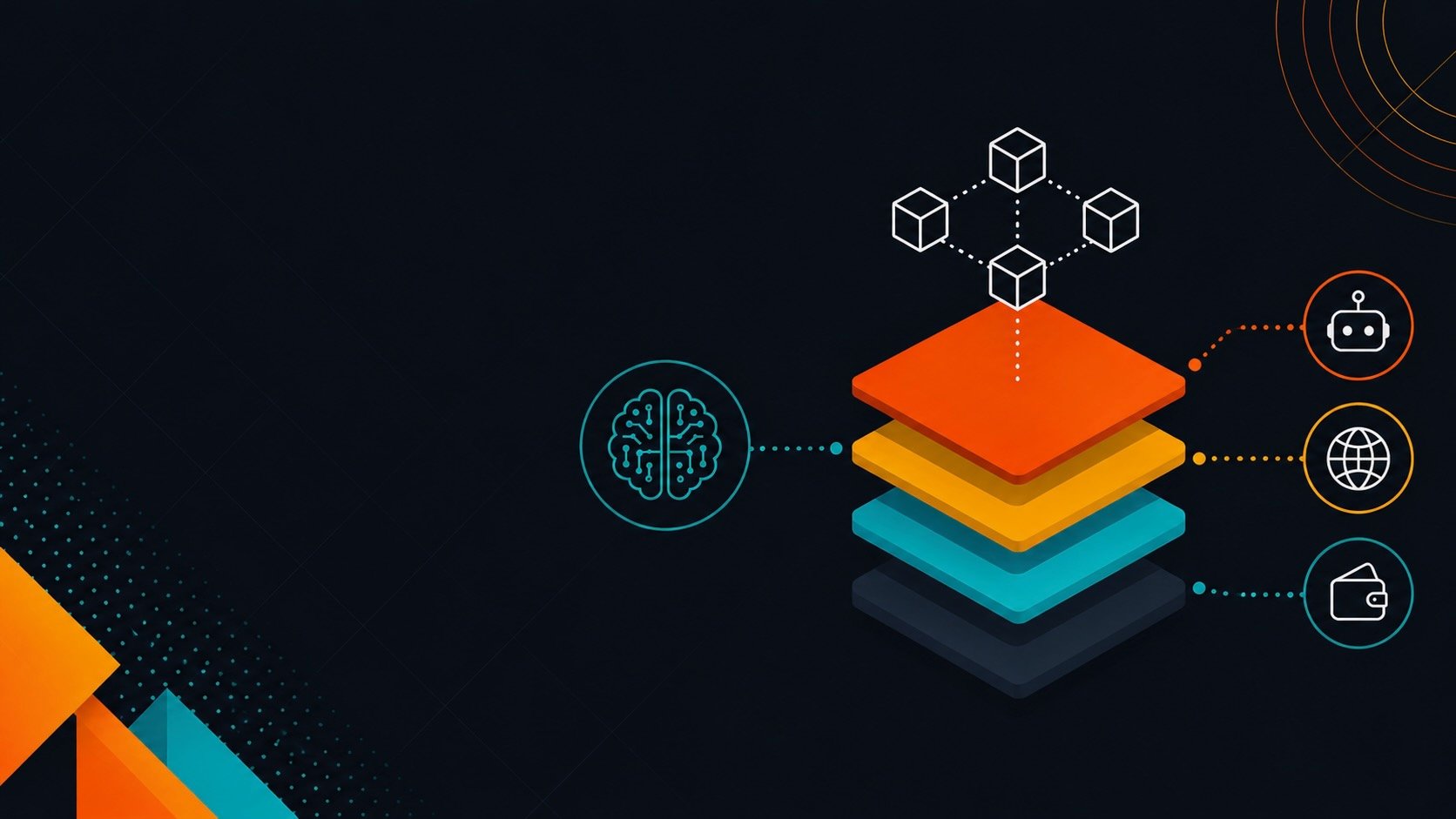


Web3 infrastructure is quietly undergoing one of its most significant transformations yet – and it has little to do with the next token launch or market cycle. The modular blockchain stack, once a technical concept reserved for protocol researchers, is now evolving into something much broader: the foundational layer for a new era of autonomous digital coordination driven by agentic AI.
Understanding this shift matters for anyone building in or navigating the Web3 space today.
From monolithic chains to modular infrastructure
Early blockchains were built to do everything in one place. A single network handled transaction execution, reached consensus, ensured data availability, and provided settlement finality. Bitcoin and early Ethereum are the clearest examples: unified systems where every node participates in every function.
The problem with this approach is scalability. When one chain must do everything, it hits limits quickly. Higher demand means higher fees, slower transactions, and pressure to make trade-offs between decentralization and performance.
The modular approach breaks these responsibilities apart. Execution, settlement, consensus, and data availability each become distinct layers that can be optimized independently. A rollup, for instance, handles execution off the main chain and posts transaction data to a separate data availability layer like Celestia or EigenDA, while settling on Ethereum. Each component does one job well instead of one system doing everything adequately.
This architectural shift mirrors what happened in software engineering more broadly – the move from monolithic applications to microservices. The logic is the same: specialization enables scale.
For builders and innovators in the crypto space, this modular foundation has opened up new possibilities. Developers can now launch application-specific chains without building validator infrastructure from scratch, plug into shared security layers, and choose data availability solutions that fit their needs and budget.
The stack is expanding beyond blockchain scaling
Here’s where things get genuinely interesting. The modular blockchain stack started as a solution to a scaling problem. But it’s increasingly becoming something else: infrastructure for autonomous AI agents to communicate, transact, and coordinate.
This might sound like a stretch, but the logic follows naturally. AI agents – software systems that can take actions, make decisions, and interact with external services on a user’s behalf – are becoming more capable and more autonomous. As they start participating in real economic activity, they need reliable infrastructure underneath them. They need to prove who authorized them, make payments, verify the trustworthiness of other agents, and leave auditable records of what they’ve done.
Blockchain’s core properties – transparent records, programmable rules, portable identity, and tamper-resistant logs – map almost perfectly onto what agentic AI requires. The stack isn’t replacing AI; it’s providing the trust and accountability rails that make autonomous agent activity safe and verifiable.


The convergence of agentic AI and decentralized infrastructure isn’t a future scenario – it’s already shaping how we think about Web3 architecture today. The projects that will define the next phase aren’t just building on blockchain; they’re building the coordination layer that lets autonomous systems act with trust, accountability, and economic purpose.
Read also: the ongoing tokenization era points to a parallel shift — blockchain is moving from purely speculative infrastructure toward systems that support real economic value. Agentic AI is accelerating that same trajectory.
The protocols shaping the agentic Web3 stack
Several emerging protocols and standards are extending the modular stack specifically to support AI agent activity. Together, they form something that could reasonably be called an agentic commerce infrastructure.
Agent Communication: A2A
A2A (Agent-to-Agent protocol) addresses how AI agents communicate with each other. The future of agentic AI isn’t one all-knowing agent doing everything. It’s a network of specialized agents, each handling a particular domain.
One agent handles research, another handles payments, another handles compliance checks. A2A provides the common language these agents use to coordinate and delegate tasks between each other.
Tool Access: MCP
MCP (Model Context Protocol) handles tool access. It allows agents to connect with external systems – databases, APIs, blockchain explorers, business workflows, payment services.
Without MCP, an agent is essentially isolated. With it, an agent can actually interact with the digital world: checking a transaction on-chain, retrieving a document, calling a pricing API, or triggering a business process.
Payment Authorization: AP2
AP2 (Agent Payments Protocol) focuses specifically on authorization. When an AI agent makes a payment on a user’s behalf, a critical question arises: was this actually authorized? AP2 is designed to answer that.
It’s less about the mechanics of moving money and more about consent, permission scopes, and accountability. Think of it as the authorization layer that sits above the actual payment.
Payment Execution: x402
x402 handles the payment execution side. It revives the old HTTP 402 “Payment Required” status code and turns it into a workable standard for internet-native micropayments.
An agent can pay for a premium data request, an API call, or even compensate another agent for completing a subtask – all automatically, without human involvement at each step. AP2 proves the agent was authorized; x402 handles the actual transaction flow.
Agent Identity and Reputation: ERC-8004
ERC-8004 tackles agent identity and reputation. As agents increasingly interact with other agents outside their own platform or organization, they need a way to evaluate trustworthiness.
Who built this agent? Has it successfully completed tasks before? Can its claims be verified? ERC-8004 aims to create an open reputation layer for agent-to-agent interactions – essentially helping agents decide who’s worth trusting and paying.
Smart wallets, spending limits, and constrained autonomy
One of the most important design questions in agentic AI is simple: how much financial autonomy should an agent have?
The answer should be: constrained. Not unlimited access to a wallet, but programmable, policy-bound access. Smart wallets and account abstraction make this possible. A user or business can configure an agent to spend only up to a certain amount per day, transact only with approved counterparties, request human approval above a certain threshold, or avoid specific transaction types entirely. Every action gets logged for review.
This matters because the goal isn’t maximum autonomy – it’s useful autonomy within clear guardrails. An AI travel agent that books the cheapest flight within your budget is helpful. An AI agent with unconstrained access to your funds is a liability.
Cross-chain coordination and the UX opportunity
AI agents won’t care which blockchain a service runs on. They’ll care whether the task can be completed quickly, cheaply, and safely. This makes interoperability a first-order concern for the agentic Web3 stack.
An agent might need to pay on one network, verify data on another, and use a service that settles on a third. Cross-chain infrastructure that handles this routing invisibly – without requiring the agent (or the user) to manually manage bridges and gas tokens – is essential for this vision to work in practice.
This connects to one of Web3’s persistent challenges: user experience. Managing wallets, private keys, gas fees, and cross-chain transfers has kept most people at arm’s length from blockchain-based services. AI agents could absorb all of that complexity. Instead of a user interacting directly with decentralized infrastructure, the agent handles it – and the user simply receives results.
That’s a genuinely compelling proposition for broader Web3 adoption. The next major interface for Web3 might not be a wallet or a dApp. It might be an AI agent. Projects like the DMCC crypto and AI ecosystem are already building regulatory and commercial frameworks that anticipate exactly this kind of convergence.
Trust, accountability, and the risks that remain
Autonomous agents create real trust challenges. They act faster than humans can supervise, may interact with unknown services, and can spend real money. Mistakes are possible. So is manipulation – fake or low-quality agents gaming reputation systems, compromised wallets, or insecure API connections.
Blockchain helps address parts of this problem. Transparent execution records, smart contract-enforced rules, verifiable identity, and auditable transaction histories all reduce the risk surface. But blockchain isn’t the brain of an AI agent. It’s the accountability layer around it. The agent decides and acts; the blockchain ensures those actions are recorded, authorized, and traceable.
The honest framing here is that agentic AI and Web3 integration is still early. Standards are fragmented, liability questions are unresolved, and regulatory frameworks haven’t caught up. As with tokenization’s positioning problem, the technology is often ahead of the governance and communication structures needed to make it work in practice. The goal should be constrained autonomy – agents that can act effectively within well-defined rules, budgets, and accountability frameworks, not agents operating without meaningful oversight.
A real-world agentic workflow: what this looks like in practice


Abstract protocol names are one thing. But how does the full agentic Web3 stack actually behave in a real scenario? Here’s a concrete example.
Say a logistics company wants to automate vendor procurement. They configure an AI agent with a clear mandate: source a certified freight partner for a shipment from Dubai to Rotterdam, negotiate within a predefined budget, and complete the booking – all without manual intervention.
Here’s what happens under the hood:
- The user defines the task and sets parameters inside a smart wallet: maximum spend of $8,000, approved vendor categories only, human sign-off required above $10,000. The agent gets to work.
- Using MCP, it connects to freight databases, logistics APIs, and compliance registries to pull live rates, carrier certifications, and regulatory requirements for the route.
- It needs help assessing carbon offset compliance for the EU leg. So via A2A, it delegates that subtask to a specialized compliance agent. That agent checks relevant registries, confirms compliance status, and reports back.
- Before committing to a vendor, the agent checks the carrier’s ERC-8004 reputation profile. The carrier has completed 400+ verified cross-border bookings, holds a strong on-chain track record, and has no dispute history. Trustworthy enough to proceed.
- The carrier’s API responds with an x402 payment request for the booking deposit. The agent checks back with AP2 to verify the payment is within authorized parameters. It is.
- The smart wallet validates the spend against the user’s policy rules and executes the transaction. The booking is confirmed, the transaction is logged on-chain, and a full audit trail is created automatically.
- The user gets a notification. Total time: minutes. Manual steps required: zero.
For businesses exploring how AI automation can power these kinds of workflows, the underlying principles align closely with what our AI automation services team builds for clients today. The difference is that Web3 infrastructure adds the trust, payment, and identity layers that make those workflows verifiable and economically sovereign.
Also worth reading: 2026 Will Be the Year of Autonomous Workflows explores how AI-driven automation is reshaping business operations more broadly.
What to watch as the agentic stack matures
The protocols and standards discussed here are still developing, but several trends are worth tracking closely:
- Adoption of x402 for API-level micropayments and agent-to-agent compensation
- AP2 becoming a standard for verifiable agent payment authorization in enterprise contexts
- ERC-8004 development as a trust and reputation layer for cross-platform agent interactions
- Smart wallet infrastructure maturing to support complex, multi-agent spending policies
- Stablecoin micropayments enabling machine-to-machine transactions at scale
- Agent marketplaces where specialized AI agents offer services to other agents or users
Each of these represents a piece of the broader picture: a Web3 infrastructure that was built to scale blockchains, now evolving to coordinate autonomous digital activity across networks, agents, and economic systems.
The modular blockchain stack isn’t just a better way to build blockchains. It’s becoming the coordination and trust layer for the next generation of the internet – one where AI agents are active economic participants, not just tools that answer questions.
If you’re building in this space or thinking about how agentic AI and decentralized infrastructure intersect with your business, our team at what. works with crypto and Web3 projects at exactly this frontier. Explore our Web3 & Crypto services to see how we can help you navigate and build in this evolving landscape.


