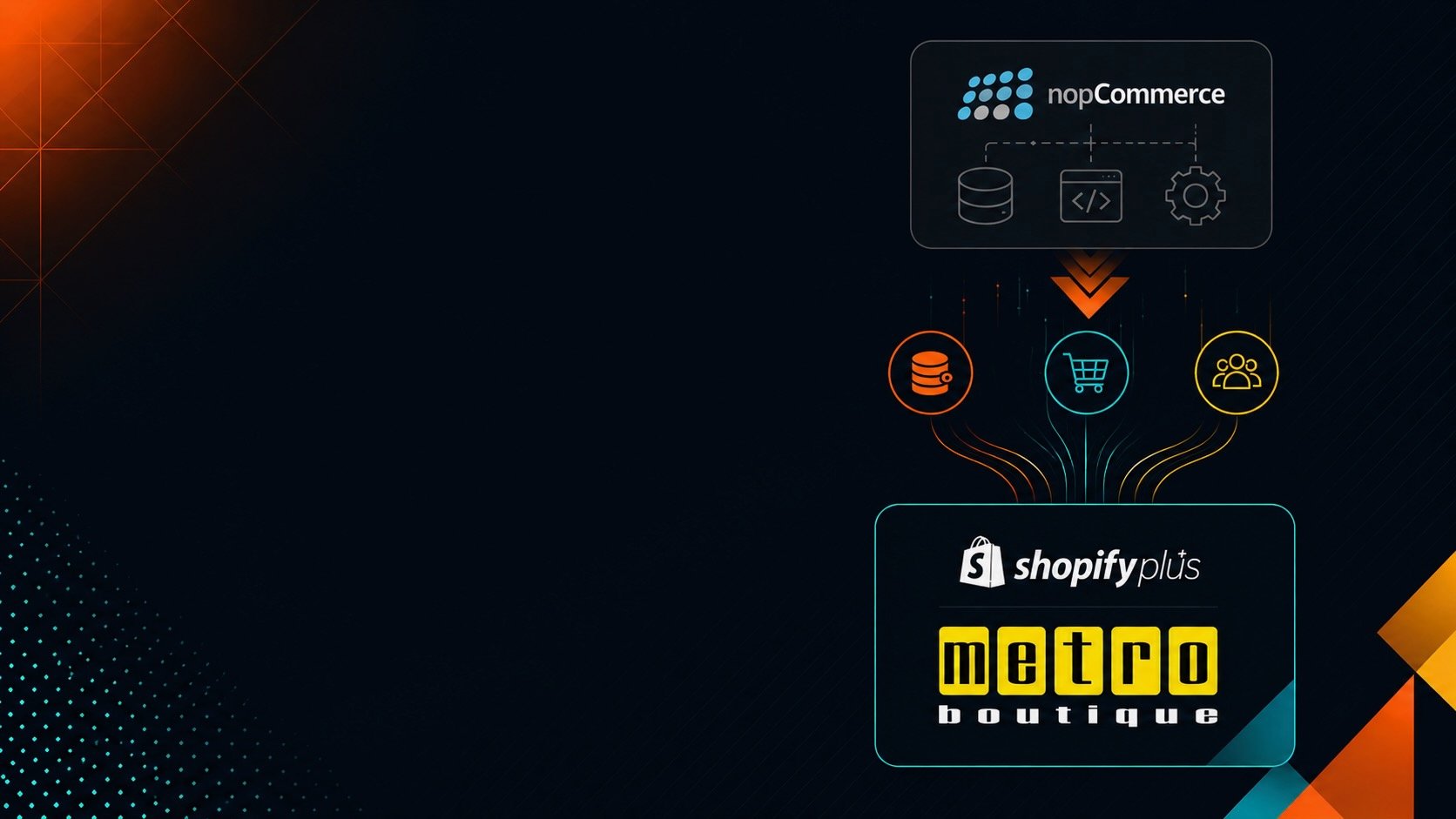


Metro Boutique is loud, colorful, and unmistakable – but its online store was none of those things. What was holding back one of Switzerland’s best-known street fashion brands wasn’t a lack of ambition. It was an outdated platform with costs that kept creeping up. Here’s how what. changed that.
Metro Boutique and the honest numbers behind the migration decision
Metro Boutique runs 25 stores across Switzerland and speaks to a crowd between 16 and 34. The online store worked – but that was about it.
The NopCommerce system from 2015 was costing CHF 250,000 a year in maintenance alone. Every content change needed a developer. Black Friday campaigns had to be manually switched on at midnight. Scheduling simply didn’t exist.
The main driver was financial: platform costs were making it harder and harder to stay profitable.
Phase 0: Business case first, migration second
what. didn’t kick things off with development. Instead, we started with a structured Store Check & Migration Assessment – the goal being to figure out, based on actual data, whether a Shopify migration even made sense, and if so, how to approach it.
The assessment came back with concrete numbers:
- 55% TCO savings over 5 years
- CHF 2 million in projected savings over the same period
- 9 million URLs in the existing store – only 88,000 of which were indexed
- 1.04% conversion rate as a starting point
That’s a business case you can actually defend internally. Management could back the decision with real numbers, not just gut instinct.
One more insight from the assessment: Metro Boutique’s strong brand identity lived primarily in its physical stores. Online, it felt muted. “Same brand, different decibels.”
The system landscape before and after the migration
| Area | Before (NopCommerce) | After (Shopify Plus) |
|---|---|---|
| Shop system | NopCommerce (2015) | Shopify Plus |
| ERP | In-house development | In-house development + prepared for Intelligix |
| PIM | Akeneo (existing) | Akeneo – custom connector (new) |
| CRM | Emarsys | Emarsys (retained) |
| Gift cards | Physical, no online use | Custom payment method (new) |
| Mobile app | In-house app (catalog + wishlist) | New API integration |
| Inventory | CSV every 5 min. | CSV sync every 5 minutes (stable) |
The three biggest technical challenges – and how what. solved them
Complex system landscapes always have spots that look straightforward on paper but aren’t in practice. At Metro Boutique, there were three of them.
Akeneo Connector
The existing Akeneo connector wasn’t up to the task for Metro Boutique’s specific data structure. The vendor was slow to respond and not particularly open to making adjustments. So what. built their own – clean, maintainable, and tailored to what was actually needed.
This comes up more often than you’d think. Off-the-shelf solutions rarely fit 100%. The difference is whether you’re willing to do something about it.
Physical Gift Cards as a Payment Method
Gift cards account for around 4% of online revenue. Shopify’s native gift card system isn’t built for physical in-store cards.
what. built a fully custom payment method that validates card balances via the external payment provider MF Group. It might sound like a minor detail – but letting 4% of revenue disappear simply wasn’t an option.
Worth noting: the old store already had this feature. The custom development simply closed the gap on the Shopify side.
App Wishlist Synchronization
The third-party solution originally evaluated caused synchronization issues. what. is currently developing their own script. This one is still in progress – and we’re being upfront about that here, because it’s part of the honest project picture.
Timeline: from proposal to go-live
The planned launch was October 2025. Actual go-live: mid-January 2026 – around 7 months after the project kicked off.
At go-live, there was no downtime, no data loss, and all critical integrations worked without a hitch.
The timeline shifted because integration quality took priority. That was the right call – going live with unresolved critical issues creates more problems than it solves.
What’s changed since launch
Denis Spycher from Metro Boutique puts it well:
“Internally, we’d been thinking about switching our shop system for a while – mainly because of high fixed costs and limited flexibility. From day one, I had a really good feeling about it. The collaboration was efficient, goal-oriented, and genuinely enjoyable. With Shopify, we now have significantly more flexibility, better efficiency in day-to-day operations, and a CMS that’s fast, intuitive, and easy to use.”
The conversion rate climbed from 1.04% to 1.08% in the first 90 days. That might sound small, but at the volume of a national fashion retailer, it adds up.
The qualitative changes are just as significant:
- The e-commerce team can now launch campaigns independently – no developers needed
- 95% of content changes are handled in-house
- Time-controlled campaign scheduling without manual activation is now possible (still to be implemented)
- The foundation for personalization, A/B testing, and SEO optimization is in place
- UX/UI improved
- Cost structure sustainably improved
And when it comes to day-to-day life for the team:
“Since going live, we’ve had a lot more freedom and can act much more proactively. For many things, we no longer need external support – we can step in ourselves, optimize the store, and test new ideas quickly. I’m convinced that Shopify Plus was the right decision for us.”
Platform costs are now around a quarter of what they used to be.


The complete technology stack
| System | Details |
|---|---|
| Shopify Plus | E-commerce platform, checkout customization, Shopify Flow (New Arrivals automation) |
| Akeneo | PIM – daily product import via custom API Akeneo connector (what.) |
| ERP (in-house development) | Inventory sync via CSV every 5 minutes |
| Intelligix | Future ERP – integration via Netix API prepared |
| Emarsys | CRM, email automation, loyalty (M-Coins) |
| MF-Group / Powerpay | Buy on account |
| Custom payment method* | Physical gift cards – custom-developed (what.) |
| Metro Boutique App | Customer app – API integration via Shopify Storefront API |
*The old store already had this feature; our custom development simply closed the gap on the Shopify side.
What this project says about the right migration approach
Shopify migration projects often don’t fail because of the technology. They fail because implementation starts too early, before anyone really understands the business case.
The assessment phase wasn’t a nice extra – it was the foundation that allowed Metro Boutique to make the decision and defend it internally. Understand first, decide next, then build.
And if an existing vendor connector doesn’t cut it, what. simply builds their own. That’s not a special case – it’s a principle. Complex system landscapes need solutions that actually fit.
Planning a similar migration?
If your platform costs are too high, your team depends on developers for every little change, or you just know your system is holding you back – the first step is an honest look at where things stand.
That’s exactly what our Shopify Migration Services are for: from the initial assessment through technical implementation to go-live and beyond. As Switzerland’s leading Shopify Plus agency with over 200 completed stores, we know where the real challenges tend to hide – and how to tackle them.


